
News
December 2025
Centre for Human Rights Education 2025 Review
As 2025 draws to a close, we at the Centre for Human Rights Education reflect on a transformational year of teaching, research and community outreach.
In February, Associate Professor Yirga Gelaw Woldeyes was appointed as the new CHRE Director. Yirga entered the role with a goal to enliven the social justice endeavours of the Centre through a renewed commitment to public outreach, external partnerships, centring marginalised voices and generating opportunities to showcase exemplary postgraduate scholarship. The Centre was also joined by Dr Azim Zahir as the new CHRE Course Coordinator, who not only led course coordination but developed new units and courses that will begin in 2027. Academic staff in 2025 included the inspiring scholars and advocates Dr Marziya Mohammedali, Dr Misty Farquhar, Dr Shamim Samani and several other who supervised the human rights dissertation students. Associate Professor Lisa Hartley was on leave for most of the year, but we are pleased to welcome her back for 2026.
Outreach
This year, the Centre engaged staff, students and the broader community in a range of public in-person and online events. Some of the in-person events included:
- The CHRE International Women’s Day Event (7 March), featuring an expert panel of scholars, lawyers, journalists and activists, including Associate Professor Mary Anne Kenny, Dr Carol Dowling, Elizabeth Lang, Associate Professor Hannah McGlade, and Mary-Anne Romano.

- “Sharpening the Pen: Activating Human Rights through Writing” (19 June), a joint event hosted with Writing WA (the peak state body for literature) at the State Library of Western Australia. It featured Magabala publisher Rachel Bin Salleh OAM, author Sisonke Msimang, and poets John Kinsella and Scott-Patrick Mitchell. The conversation, facilitated by CHRE Director Yirga Gelaw Woldeyes, centred on writers’ and readers’ obligations to engage in activism and truth-telling on and off the page.

- The 2025 Curtin University Annual Human Rights Lecture (15 September), CHRE’s cornerstone public event. Dr Tracy Westerman AM, leading Indigenous psychologist and advocate, gave this year’s address to a sold-out crowd. It was opened by Indigenous Elder Kim Collard, who gave a moving Welcome to Country, and Curtin’s Vice-Chancellor Professor Harlene Hayne, whose opening remarks acknowledged the importance of CHRE’s 22-year history of human rights advocacy, teaching and research. (Photo 3)
This year’s Annual Human Rights Lecture is accessible to view here.

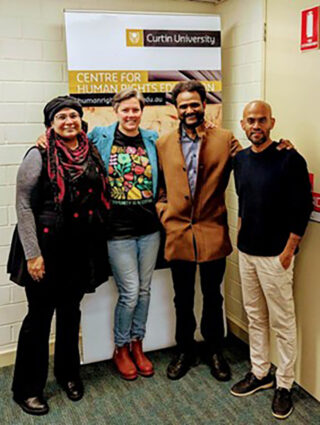
Additionally, CHRE developed a partnership with the Australian Council for Human Rights Education (ACHRE) to host joint bi-monthly webinars on pressing human rights issues. The goal was to share critical human rights voices with students, scholars and the broader public across Australia. Our webinars this year included:
- “Young Voices” (27 March), featuring inspiring young activists Anhaar Kareem, Ella Simons and Liv Sutherland addressing youth concerns on the climate, voting rights and Indigenous sovereignty.
- “Gender Justice Now!” (28 May), featuring esteemed leaders on gender equality Dr Anna Cody (Australia’s Sex Discrimination Commissioner), Dr Sandra Nasr (Learning and Development Specialist, Zonta House Refuge Association) and Dani Villafaña (Co-founder of YASVA, Youth Against Sexual Violence Australia).
- “Reflecting on NAIDOC 2025” (31 July), featuring leading Aboriginal advocates Professor Lynette Riley (NAIDOC Co-Chair), Liz Gordon (Acting National Commissioner for Aboriginal & Torres Strait Islander Children and Young People) and Marleigh Zada (Coordinator of Enabling Courses, Centre for Aboriginal Studies at Curtin).
- “The Future of Human Rights in Turbulent Times” (4 November), featuring Jeswynn Yogaratnam (Northern Territory Anti-Discrimination Commissioner), Professor Linda Briskman (Margaret Whitlan Chair of Social Work), and Elaine Jung (UNICEF Australia Partnerships & Philanthropy Manager).
All of these webinars are now available to review via posts on CHRE’s Facebook and LinkedIn.
The Centre has also just developed a new partnership with the ASEAN University Network – Human Rights Education (AUN-HRE), which was kicked off on 10 December with a webinar on “Human Rights Education for Transformative and Peaceful Societies”. Hosted by AUN-HRE Convenor Dr Vachararutai Boontinand, this panel featured CHRE Director Yirga Gelaw Woldeyes and Dr Rommel B. Rodriguez (University of the Philippines) for an enlivening discussion on how universities can turn human rights principles into real world impacts. Our Course Coordinator, Azim Zahir, also offered insights into CHRE’s approach to teaching human rights. Azim also joined the Careers in Human Rights Panel hosted by Amnesty UWA and the PPE Union — sharing insights on building a meaningful career in this vital space. The event allowed students to ask questions about what opportunities exist with studying human rights at Curtin University.
Individual CHRE academics, including Emeritus Professor Baden Offord, Associate Professor Yirga Gelaw Woldeyes and Dr Azim Zahir, also spoke at academic conferences, literary festivals, online seminars and public events, all with the goal of bringing their research-informed human rights insights to a range of audiences. Behind the scenes, they also engaged with high-profile human rights organisations and diplomats to discuss future joint ventures to enliven human rights through advocacy and teaching initiatives.
Teaching
Our postgraduate teaching continues to be at the forefront of everything we do. Vice Chancellor Professor Harlene Hayne acknowledged CHRE at the 13 June All Staff Forum, noting that the Master of Human Rights received the highest level of student satisfaction (100%) across the university in 2024. In 2025, we continue to engage our student cohort in social justice led learning and dialogue.
Our students come from all over the globe, with backgrounds in law, advocacy, government, NGOs, private industry, journalism, the arts and education. They bring a vast array of experiences to the classroom, offering a plurality of perspectives to their fellow students and lecturers. Acknowledging this, CHRE sought to provide an avenue for their important insights to reach beyond the classroom. With funding support from Curtin University’s School of Media, Creative Arts and Social Inquiry, we published a book of student papers on development and infrastructure.
During this project, students developed their own critical responses to infrastructure developments of their choice and then went through the academic peer-review process. They received added guidance, support and editorial advice to bring their work up to publication standard. The result is the book Infrastructure for Life, or Life for Infrastructure: Critical Journeys on the Road to Development (edited by Yirga Gelaw Woldeyes, Azim Zahir and Rebecca Higgie), which can be freely accessed here.
Research
Staff at CHRE continue to publish research on human rights issues in high-impact journals and publications. CHRE Director Yirga Gelaw Woldeyes continues to conduct critical research on roads development in his role as Chief Investigator on the ARC Discovery Grant “Roads to the Future”. He has also published new academic journal articles, including “Human Rights and the Nation State in the Global South: A Genealogical and Decolonial Critique” in the Journal of Human Rights and “Centering the Sacred: Reflections on Princeton’s Collection of Ethiopian Kitab Scrolls” in The Princeton University Library Chronicle (forthcoming). His Hungerford Award winning book የተስፋ ፈተና / Trials of Hope, which creatively articulates his academic research on human rights, decolonisation and linguistic rights, recently went to print and will be out with Fremantle Press in early 2026.
Dr Azim Zahir presented his research on religious nationalism as part of Curtin’s Social Sciences Seminar Series and has two forthcoming book chapters: one in Understanding the Politics of Human Rights (Edward Elgar Publishing, 2027) and another, co-authored with Yirga Gelaw Woldeyes, in Globalisation, Human Rights and Decolonisation (Springer, 2026). Dr Zahir is also collaborating with MCASI colleagues Professor Farida Fozdar (FASSA) and Dr Cathy Martin on a project examining cultural diversity and social cohesion, with plans to host a research symposium in December 2026.
Associate Professor Lisa Hartley returned from extended leave in October and continued her involvement in CHRE’s research and collaborative projects. This year she co-authored two publications with colleagues in Australia, Aotearoa New Zealand and the UK, including work on decolonising solidarity in higher education and on the role of academic activism. Her ongoing scholarship maintains a focus on equity, refugee rights and community-engaged approaches in human rights research. She is also continuing collaborative work examining the meaning of “workplace readiness” for students from culturally and linguistically marginalised backgrounds.
As noted above, the new CHRE book of student papers Infrastructure for Life, or Life for Infrastructure: Critical Journeys on the Road to Development also provides an important contribution to the field of human rights research. It demonstrates how students are partners in advancing human rights scholarship, bringing fresh ideas to the field.
This book is the second volume of student papers published by CHRE, following on from the 2021 book Voices from the Darker Side of Development. Both books showcase the rigorous, justice-led work of our incredible students, while also adding important emerging voices to human rights scholarship.
Recognising the growing diversity of our student cohort, particularly from the Asia–Pacific region, CHRE engaged in a range of outreach activities to support prospective students. Notably, Dr Azim Zahir presented at the Curtin Global Agent Counsellor Workshop in Kochi, India, to provide detailed information on its postgraduate programmes.

New Specialisation and Unit for 2027
This year, CHRE undertook a comprehensive course review, led by Dr Azim Zahir, of its flagship postgraduate teaching programmes, and proposed a new undergraduate specialisation in Human Rights for 2027. This marks the Centre’s first expansion into undergraduate teaching. Reflecting its commitment to cutting-edge research and pedagogy, CHRE will also introduce a new unit in 2027 examining major contemporary global challenges, including climate change and rising intolerance across the globe, and their impacts on human rights.
Thank you
This year could not have been possible without the tireless work of our excellent staff and students, as well as former Directors and alumni who continue to engage with the Centre. Alongside our new courses in 2027, we seek to further work with our special community on our shared goal of advancing human rights. In 2026, we also look forward to celebrating the 10th anniversary of the Annual Human Rights Lecture, and the 23rd year of the Centre’s leading work in human rights advocacy, teaching and research.

August 2023
Advocacy win for asylum seeking children in Western Australia
The Centre for Human Rights Education (CHRE) achieved a fantastic advocacy win for asylum-seeking children in Western Australia who face barriers to participating in community sports due to their lack of access to state and federal government financial support. Since 2021, CHRE Co-Director Lisa Hartley and Sobia Shah, Co-founder of the Professional Migrant Women’s Network, have been advocating to the Department of Local Government, Sport and Cultural Industries to expand the eligibility criteria for the KidsSport program – which provides financial assistance to eligible children to participate in community sports – to include asylum-seeking children. On 22 August 2023, it was announced that asylum-seeking children are now eligible for the Kidsport program! This welcome change will make a big difference for some of WA’s most marginalised children.
Read here for more information.
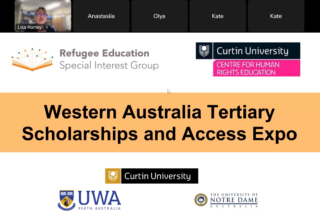
Webinar: WA University Scholarships & Access for People from Refugee and Asylum Seeking Backgrounds
On 17th August, Associate Professor Lisa Hartley in her capacity as the Centre for Human Rights Education Co-Director and Co-Chair of the Refugee Education Special Interest Group, hosted a webinar on WA University Scholarships & Access for People from Refugee and Asylum Seeking Backgrounds on Temporary Visas. In the webinar, colleagues from Curtin University, The University of Western Australia, and The University of Notre Dame Australia provided an overview of the full-fee waiving scholarships on offer for people seeking asylum and refugees on temporary visas. Dr Asher Hirsch from the Refugee Council of Australia also gave an overview of the policy landscape for people seeking asylum and access/lack of access to government support. Two former scholarship holders also shared their expertise and insights about studying at WA universities which was followed by a Q and A session.
Watch the recording of the webinar by clicking here.
ASRC Community Advocacy and Power Program, Perth
CHRE Co-Directors Caroline Fleay and Lisa Hartley are working alongside a number of community partners – The Professional Migrant Women’s Network Inc, CARAD – Centre for Asylum Seekers, Refugees, and Detainees, and the Asylum Seeker Resource Centre – to deliver the Community Advocacy and Power Program in Perth in September/October.
This program is for people in Western Australia from an asylum-seeking or refugee background who would like to develop their skills in advocacy, community organising/mobilising, public speaking and effective media engagement to make their voices heard.
Applications close on 20th August – https://asrc.org.au/community-advocacy-and-power-program/
CHRE supporting the Voice to Parliament
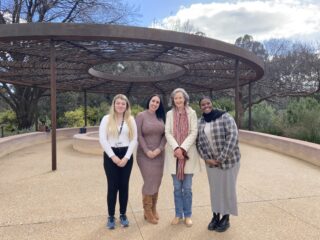
Humanities Dean of Indigenous Futures Mandy Downing and Centre for Human Rights Co-Director Caroline Fleay are working alongside video producers Catherine Blakey and Lula Elmi to develop a short video about the upcoming referendum and need for a First Nations Voice to Parliament in the Australian Constitution. They spent a sunny afternoon at the Curtin Yarning Circle on 9 August where Mandy and Caroline and several other students and staff were filmed about why they are supporting the Voice to Parliament. This followed a yarning circle organised by CHRE and led by Professor Simon Forrest informing students and staff about the upcoming referendum and the Uluru Statement of the Heart. Another yarning session is planned for late September – watch this space…
Concern for ethnic-based human rights in Ethiopia and alternative conflict resolution recommendations
Centre for Human Rights Education’s Dr Yirga Woldeyes, Senior Lecturer and Multidisciplinary Researcher, was interview by SBS Amharic in early August about the new conflict the Ethiopian government has launched against the Amhara people in Ethiopia. Yirga discusses the human rights implications of the war on Amhara people and possible options to stop it.
WA University Scholarships & Access Webinar for People Seeking Asylum
Lisa Hartley in her capacity as Co-Director of the Centre for Human Rights Education and Co-Chair of the Refugee Education Special Interest Group is hosting an interactive online information session on access to Western Australian higher education for people from refugee and asylum seeker backgrounds living on temporary visas in Australia. The webinar will be 17th August 4-5:15pm AWST.
Receive information about admission and scholarship applications from representatives from Curtin University, Notre Dame University and UWA. These three institutions currently offer full-fee waiving scholarships for people from refugee and asylum seeker backgrounds living on temporary visas. Hear from previous scholarship holders and their experience accessing universities in WA with a question and answer session.
Register here to attend.
July 2023
Calls for a meaningful pathway to permanency and family reunion for all people seeking asylum
The Centre for Human Rights Education’s Associate Professor Caroline Fleay and our very good friend Associate Professor Mary Anne Kenny have released a briefing paper calling for a meaningful pathway to permanency and family reunion. All people seeking asylum who arrived to Australia by boat a decade or more ago urgently need to be able to settle here and reunite with their families. Read the paper here.
June 2023
Yarning Session with Emeritus Professor Simon Forrest
On Saturday 17th June, the Centre for Human Rights Education (CHRE) was honoured to host its first yarning session with Emeritus Professor Simon Forrest about the Aboriginal and Torres Strait Islander Voice to Parliament and The Uluru Statement from the Heart.
Simon generously gave his time to share how a Yes vote in the upcoming ‘Voice to Parliament’ referendum will provide a pathway for Indigenous Australians to speak directly to the Australian government about the things that work on the ground in their communities. It will also recognise the world’s oldest living culture in Australia’s Constitution, for the first time. We appreciate Simon sharing his knowledge.
As we head towards this incredibly important referendum, CHRE encourages all to learn as much as they can. This website is an excellent resource. yes23.com.au

Multicultural Communities Council of WA’s Refugee Week symposium 2023
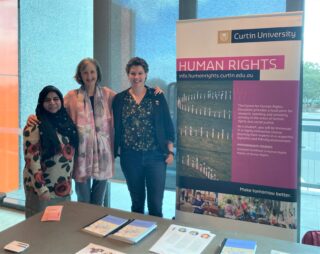
The Centre for Human Rights Education’s A/Prof Caroline Fleay, sessional academic Misty Farquhar and our very good friend, Sobia Shah, from the Professional Migrant Women’s Network, all presented at the Multicultural Communities Council of WA’s Refugee Week symposium in Perth last Friday 16 June. Finding Freedom: Refugee Mental Health and Inclusion brought together members of refugee communities, agencies, government departments and academics to raise awareness about the impacts of government policies on the mental health of people from a refugee background, and how policy responses, practices and advocacy need to be inclusive and guided by a diverse range of lived experiences.
May 2023

CHRE Statement in support of the Aboriginal and Torres Strait Islander Voice to Parliament
All of us at CHRE would like to pay our respects to the First Nations peoples across Australia. We are here on Whadjuk Noongar boodja and we pay our deep respects to their Elders past and present, and acknowledge that this land was never ceded.
We remember so well what an extraordinary moment it was in Australia’s history when so many of this country’s First Nations peoples gifted the Uluru Statement from the Heart to us all. We consider this to be a profoundly important document and a moment of reckoning in our country’s history. The Uluru Statement from the Heart provides us with a guide to how we may all move forward together to create a better future.
The Uluru Statement from the Heart clearly maps out the need for Voice, Treaty and Truth. This includes the need for a First Nations Voice to Parliament that is enshrined in the Constitution, and a Makarrata Commission to supervise a process of agreement-making and truth-telling.
We support the proposed changes to the Constitution that will enshrine the Aboriginal and Torres Strait Islander Voice to Parliament within this fundamental law. We also very much appreciate and respect that there are a range of different views regarding the Voice to Parliament, and how important it is to listen deeply and learn from First Nations peoples about their perspectives on the Voice.
As a human rights teaching, research and advocacy centre, we also consider that it is imperative to learn about Australia’s short history as a nation and why a referendum is being called at this moment in time. Like many others, we see that it is of the utmost importance to develop a deep understanding of the Uluru Statement from the Heart, and the proposed Aboriginal and Torres Strait Islander Voice to Parliament.
We acknowledge too the personal impacts on First Nations peoples as this national conversation progresses, and how utterly important it is that we all engage in respectful dialogue.
As much continues to be discussed about the referendum in many public and private forums, we remember that the Aboriginal and Torres Strait Islander Voice to Parliament is a modest proposal. But we consider that it also holds the potential for profound change in policy making, and for all of us in Australia to move forward together.
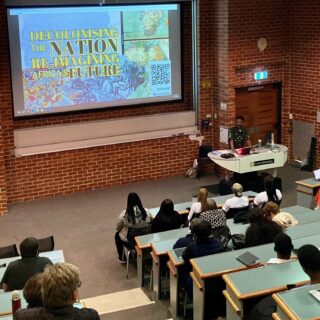
Centre for Human Rights Education Africa Day Event 2023
The Centre for Human Rights Education, in collaboration with the Curtin African Student Association and Curtin International Relations Society, organised a public event to commemorate Africa Day in 2023. At the event, Curtin students from African backgrounds read poems and shared their lived experiences and what Africa’s history and identity means to them. CHRE co-director Associate Professor Lisa Hartley reflected on CHRE’s 20 years of critical research and advocacy for social and epistemic justice across the world including Africa. CHRE’s Dr Yirga Gelaw Woldeyes presented the Curtin Africa Day inaugural lecture titled: Decolonising the nation and reimagining Africa’s Indigenous futures. The event was well attended in person and online. The event is part of CHRE’s celebration of its 20th anniversary of teaching, research, and advocacy at Curtin University.
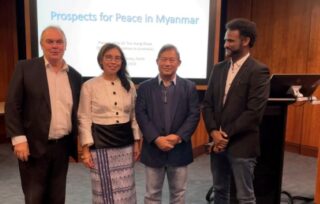
Human Rights and Prospects for Peace in Myanmar
On Monday 22 May, the John Curtin Institute of Public Policy and the Centre for Human Rights Education co-hosted officials representing the National Unity Government of Myanmar for a special presentation on human rights and prospects for peace in the nation.
His Excellency Aung Myo Min, Union Minister for Human Rights, was represented by Dr Tun Aung Shwe, official representative of the Myanmar Government in Australia, after falling ill ahead of the presentation. Dr Shwe reflected on the ongoing effects of Myanmar’s 2021 military coup and shared the Minister’s vision for a pathway to peace.
Celebrating 20 years of the Curtin Centre for Human Rights Education
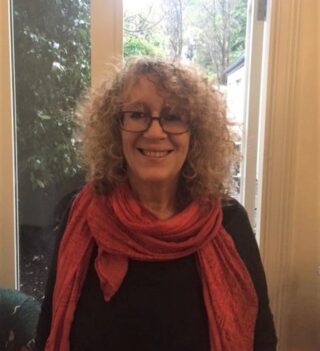
In 2023, the Centre for Human Rights Education (CHRE) is 20 years old. CHRE will also be hosting a series of events later in the year celebrating 20 years of human rights teaching, research and advocacy. To kickstart the celebration, CHRE has a current social media campaign showcasing the impact that CHRE has had on former/current CHRE staff and student’s lives. See below for former Dr Haruhisa Handa Chair of CHRE (2006-2011), Professor Linda Briskman’s celebratory post. Follow for updates on Facebook or Instagram.
“Twenty years on & CHRE is as relevant as when it began. It occupies a special place at the University as a retreat from neoliberalism, competition & managerialism. Through non-hierarchical & collaborative ways of working, CHRE tackles the most pressing issues facing Australia & the world. Underpinning scholarship & teaching is compassion that steers advocacy for social change. Through its national & international reputation & partnerships, CHRE upholds the highest level of human rights and ethics. I am proud to be associated with CHRE where five of the best years of my life were spent with the most remarkable academic community.”
March 2023
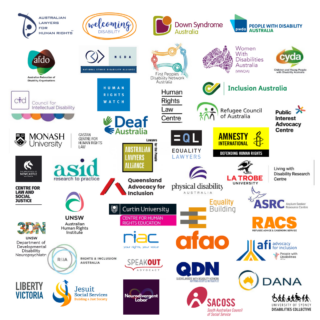
Welcoming Disability Open Letter
The Centre for Human Rights Education has joined 100+ organisations and experts calling for urgent reform of Australian migration health laws to remove their discriminatory impact on people with disability and health conditions. Families already part of Australian society should not have to leave because they have a child with a disability or health condition. The Open Letter is part of the Welcoming Disability campaign led by Down Syndrome Australia and Australian Lawyers for Human Rights.
See the full open letter here: Over 100 organisations and experts call on federal government to end Australia’s discrimination against migrants with disabilities
September 2022
Addressing skills shortages and supporting economic growth in Australia: Permanent pathways for temporary protection visa applicants
New briefing paper from John van Kooy and the Centre for Human Right’s Caroline Fleay just released! Providing permanent residency and family reunion to all who have applied for a temporary protection visa in Australia will finally enable them to settle here, and help to address the skilled labour shortages in Australia.
Read the full paper here.
March 2022
On the 9th of March, Dr Lisa Hartley had an article titled, ‘Lessons from the pandemic on fairer and more caring uni teaching and learning‘, published in The Conversation with colleagues Dr Sally Baker, Dr Joel Anderson, Dr Tebeje Molla, and Dr Rachel Burke.
Based on the findings from their National Centre for Student Equity in Higher Education funded research led by Dr Sally Baker, UNSW, which investigated the challenges and opportunities of Covid-19 induced remote delivery for CALD, migrant & refugee students & university staff.
New Research Report: COVID-19 online learning landscapes and CALDMR students: Opportunities and challenges
A research project led by UNSW’s Dr Sally Baker, involving CHRE’s Dr Lisa Hartley and co-investigators from the Refugee Education Special Interest Group , has found that the rapid move to Online Learning due to the COVID-19 pandemic has created new educational and social vulnerability for culturally & linguistically diverse migrant &/or refugee communities (CALDMR).
CALDMR students were also found to not be equipped for online learning and virtual classrooms. Many factors negatively impacted outcomes for students, including: finances, mental health and wellbeing, living and learning environments, ability to access computers and the internet, and ability to access support services via institutions.
Research recommends universities to:
- Provide emergency funding to create nuanced resources for CALDMR students.
- Establish better methods of identifying and interacting with CALDMR students once they are engaged in higher education.
- Provide targeted support through dedicated staff, engagement programs and teaching/learning resources.
Read the full report here.
February 2022
Dr Yirga Woldeyes at the Perth Writers Festival
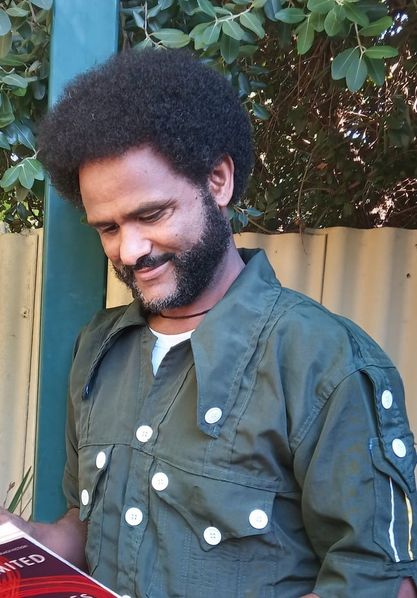
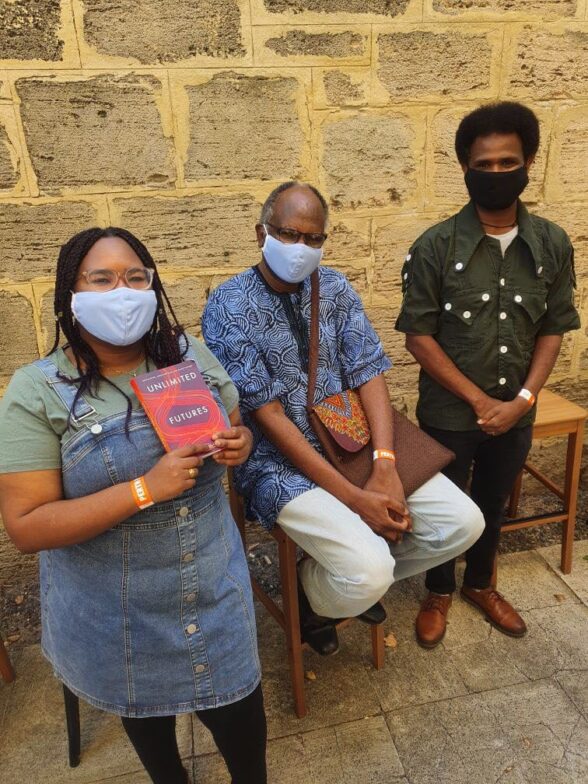
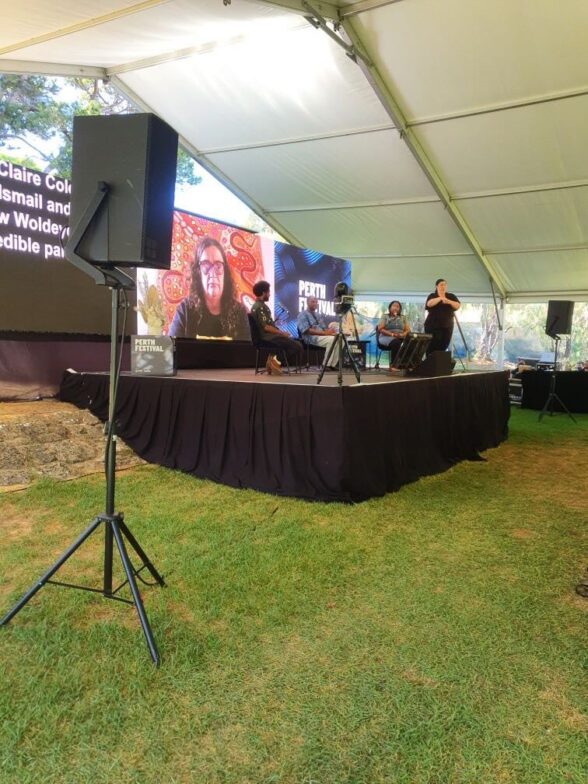
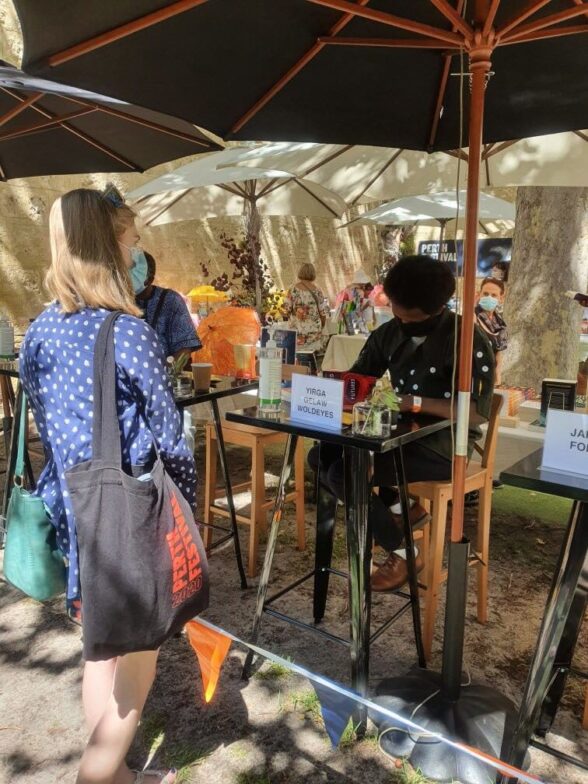
On 27 February 2022, Dr Yirga Woldeyes spoke at the Perth Writers Festival, sharing the stage with writers Claire G. Coleman, Afeif Ismail, and Rafeif Ismail. The writers discussed the new book “Unlimited Futures: Speculative, Visionary Blak and Black Fiction” (Fremantle Press). Yirga’s poem “እኔ ሃገር የለኝም / I have no country” is published in the book in both Amharic and English, and Yirga read the poem in Amharic at the Festival.
Photos courtesy Yirga Woldeyes.
December 2021
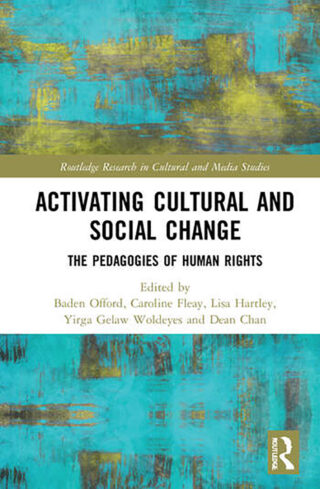
New Book – Activating Cultural and Social Change: The Pedagogies of Human Rights
The Centre for Human Rights Education is very excited to announce that “Activating Cultural and Social Change: The Pedagogies of Human Rights” was published on 24 December 2021.
Co-edited by Baden Offord, Caroline Fleay, Lisa Hartley, Yirga Gelaw Woldeyes and Dean Chan, the book includes a diverse range of educators, activists, academics, and community advocates provide theoretical and practical ways of activating our knowledge and understanding of how to build a human rights culture.
An official launch will take place in 2022.
Moving, inspiring and critical chapters written by Leticia Anderson, Misty Farquhar, Marcelle Townsend-Cross, Carol Dowling, Muzafar Ali, Greg Watson, Katie Ellis, Gerard Goggin, Karen Soldatić, Nina Burridge, Linda Briskman, Sukhmani Khorana, Sonia Tascón, Jim Ife and many others.
Purchase a hard copy or ebook from Routledge.